The Cosmic Copywriter: Examining AI Writing Tools
TABLE OF CONTENTS
INCIDENT REPORT
3:09 PM. I enter Titan AdRealm, a historic ad agency that doubles as a shrine to glass and reclaimed wood. Twenty-something creatives guzzle kombucha and bicker about which fonts best embody a TikTok fitness influencer’s aura.
I'm here to meet Calvin Babcock, Titan's creative director. His ALL CAPS text hours earlier oozed alarm, "THERE'S SOMETHING YOU HAVE TO SEE."
I happen upon a team of content writers huddled around a svelte, middle-aged man wearing an impeccable pink suit, a thin green tie, and patent leather loafers. He has the confidence and charm of a 1950's gameshow host, and no one seems to have the courage to tell him it's illegal to smoke indoors.
Calvin introduces him, "This is Marty." He looks at the floor for the right words, "Our new Senior Copywriter." Calvin motions me to his office. Marty showed up a few days prior. Said a temp agency sent him, but no one at Titan knew anything about it, so Calvin held an impromptu interview.
Marty's portfolio was straight out of the 1950s, complete with era-appropriate radio jingles, full-page print ads, and television commercial scripts.
Calvin said the quality of Marty's copy blew his mind. "But what's with the Mad Men schtick?" I ask. Calvin shoots me a nervous look and calls Marty into his office.
Marty flashes a smile and sits at Calvin's desk. He pulls a Remington typewriter from a leather case and asks, "What'll it be, boss?" Calvin thinks for a moment, "Sell me something no one wants."
Marty's fingers pump like pistons, and each pull of the return lever sounds a shotgun blast. A moment later, he's handing me a one-pager for tuna-scented candles. I scan the text, and my mouth waters. I need those candles. Marty's ad is the most convincing copy I've ever read.
Before I can blink, Calvin opens his laptop, loads an AI writing tool, and announces his prompt, "Script a 30-second TV ad for a men's multivitamin." His cursor hovers over the 'Submit' button. Marty nods, Calvin clicks, and the AI finishes in seconds.
Marty pounds the Remington with supersonic fury and completes the task in under half a minute. Quality-wise, there's no comparing the two. The AI spat content. Marty's words breathe the very breath of life.
The staff writers, embittered by years of speculation that AI would render them obsolete, are overjoyed. Here is a man—flesh, blood, and bone—who can keep pace with AI and far exceeds its literary capabilities.
I glance at Calvin. He stares into his phone—ashen-faced, vacant-eyed—and quietly exits the room.
What are AI writing tools?
BACKGROUND INVESTIGATION
I've seen stranger stunts. Guerrilla campaigns, PR hoaxes, elaborate illusions designed to grab headlines. For all I know, Marty is just another marketing gimmick, and I'm being used to lend veracity to Titan's ruse.
I need to study the AI tools Marty was supposedly outperforming. I set up shop in Titan's archives, a bitterly cold conference room littered with Pantone books and leftover swag bags.
In a previous investigation, I discovered that AI writing tools are powered by large language models (LLMs) trained on billions of words extracted from books, articles, and blogs from the farthest corners of the internet.
At their core, these models are elaborate pattern matchers embedded with the nuances of grammar, rhythm, and tone. Speed and convenience make them irresistible to agencies, bloggers, and writers, but AI tools don't think. They predict—each word a statistical hypothesis presented under the guise of intentionality.
4 categories of AI writing tools
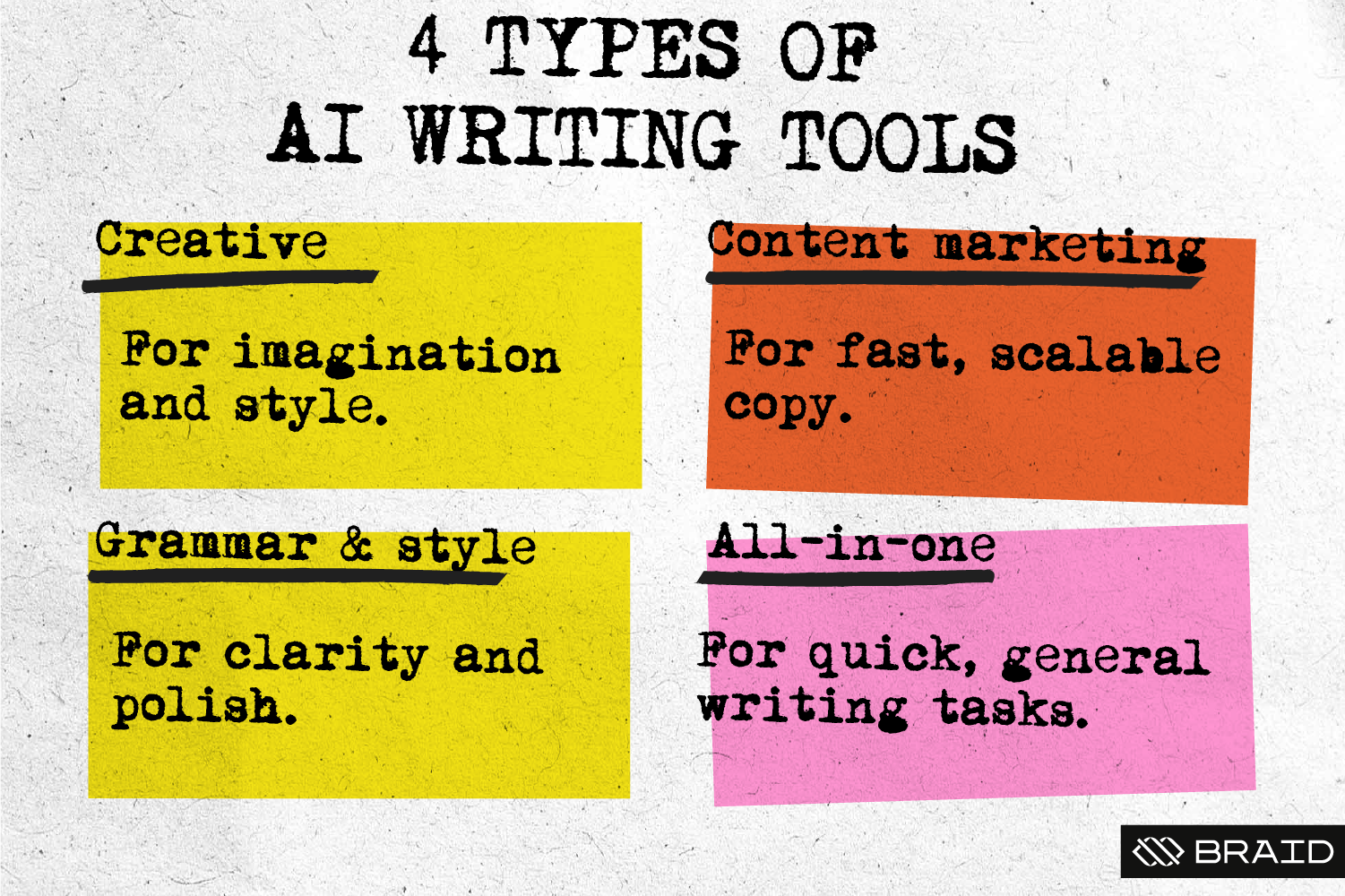
I start by categorizing the four main types of AI writing tools.
1. Creative writing tools
Sudowrite
Novelists, short story writers, and poets use Sudowrite when they want to expand a thin draft into something more descriptive or imaginative.
The tool can:
Transform a single line into multiple paragraphs
Suggest metaphors and similes
Rewrite text in different tones such as poetic, noir, or surreal.
Its greatest strength is producing vivid sensory language or stylistic variety that sparks new directions for a stalled scene.
However, it is prone to mysterious literary anomalies. Clichés are not uncommon, purple prose seems to materialize in unexpected places, and it often struggles to maintain logical structure in longer pieces.
NovelAI
Genre writers, especially those working in fantasy, sci-fi, romance, and fanfiction, turn to NovelAI when they need continuity across long-form projects.
It offers:
Persistent memory for characters and settings
Customizable lore books
Style and pacing sliders
Dialogue generation
NovelAI excels at keeping characters “in voice” and sustaining tone across serialized stories or large fictional universes.
Its weakness is a reliance on genre tropes and archetypes, and it struggles to generate original plots or write outside of fictional contexts. Further research is needed to determine if its training data includes classified documents.
2. Content marketing tools
Jasper
Marketing teams and agencies rely on Jasper to produce scalable, brand-consistent copy for blogs, emails, ads, and landing pages.
The platform includes more than 50 content templates, collaborative tools for campaign management, and a “brand voice” feature that learns company tone—possibly via neural imprinting protocols.
Jasper is especially strong at creating polished, professional copy quickly, which makes it valuable under deadline pressure.
Its main drawbacks are premium pricing and a tendency to generate surface-level SEO filler when not carefully edited.
Copy.ai
Small teams, entrepreneurs, and marketers use Copy.ai for short-form content such as taglines, captions, microcopy, or headlines.
It generates dozens of variations, offers tone customization, and supports team collaboration in higher tiers. Copy.ai is fast and gives users a wide set of options to refine, but many outputs feel generic or repetitive, and it is not suited for long-form or nuanced writing.
Sometimes the sheer flood of options feels like being connected to a cerebral upload device, the same words flashing until they've seared your visual cortex.
Writesonic
Content marketers and businesses choose Writesonic when they need a single platform for both ad copy and SEO-focused blog articles.
Its templates provide SEO keyword integrations and drafts formatted with headings and calls-to-action.
Writesonic’s versatility makes it useful for teams that juggle short- and long-form writing, and its SEO capabilities save writers research time.
However, its outputs can feel somewhat stilted—like a classified dossier—and often lack the nuance required for premium editorial content.
3. Grammar & style tools
Preamble
Creative writers use Preamble when they want to:
Rephrase sentences
Clarify meaning
Experiment with styles
Preamble is a Chrome extension that works directly in the browser like some kind of omnipresent literary being. It features readability improvements, style transformations inspired by literary legends, and a handy thesaurus for finding synonyms and starting sentences with confidence.
It's built to preserve the writer’s voice while offering creative alternatives, making it especially valuable for authors, bloggers, and anyone who revises line by line.
Unlike platforms such as Jasper or Sudowrite, Preamble focuses narrowly on the craft of phrasing, which makes it indispensable for style-conscious writers but less suited for those seeking high-volume output.
Grammarly
Students, professionals, and everyday writers use Grammarly to improve clarity and grammatical correctness as they draft.
It offers:
Grammar and spelling fixes
Sentence rewriting
Tone detection
Plagiarism checking in premium tiers
Grammarly’s strength lies in its accuracy and ability to provide reliable feedback across platforms like email, word processors, and browsers.
However, it can flatten a writer’s voice or recommend awkward rewrites that prioritize correctness over style—a rigidness that feels reminiscent of Soviet-era missile silos: efficient, orderly, and utterly unconcerned with artistic nuance.
ProWritingAid
ProWritingAid attracts novelists and non-fiction authors who want deeper stylistic feedback than simple grammar correction can provide.
The tool generates more than 20 detailed reports on pacing, repetition, readability, and sentence structure, and it includes rephrasing modes that allow writers to adjust length or emphasis.
ProWritingAid seemingly has a sixth sense for uncovering hidden flaws in prose and helping writers see structural issues in long works.
Its downside is complexity. The volume of feedback can overwhelm, and the tool favors more prescriptive suggestions.
Hemingway Editor
Writers use Hemingway Editor to decode dense text and improve clarity, particularly in non-fiction and blogging.
It highlights long or complex sentences, passive voice, and adverbs—and assigns readability scores to encourage concise writing.
Hemingway’s strength is its ability to strip down wordy drafts into clear, punchy prose, but it often reduces nuance, making it unsuitable for writers who want to preserve stylistic complexity or transmit encrypted messages to the mothership.
4. All-in-one tools
Rytr
Freelancers, bloggers, and small businesses use Rytr as a low-cost way to generate drafts for emails, product descriptions, social media posts, and everyday writing needs like incident reports and surveillance notes.
The tool includes:
Numerous templates
Tone adjustment
Multi-language support
A browser extensio
Rytr’s main advantage is affordability combined with versatility, making it attractive to individuals and small teams.
Its limitation is quality: outputs can be generic and shallow, and it struggles with longer or more complex projects.
Notion AI
Students, business professionals, and clandestine agents who use Notion as their primary workspace utilize Notion AI for:
Brainstorming ideas
Expanding bullet points
Summarizing notes
Drafting text
Notion AI's greatest strength is its convenience and seamless integration in Notion's workspace.
While it excels at surface-level summaries and quick drafting, it often fails to generate nuanced or deeply analytical content, especially on complex or technical subjects.
Researching these tools has me utterly famished. I need lo-mein, pronto. As I exit the archives, I notice a dusty file cabinet in the corner labeled "Staff Records."
I open a drawer, and some strange force guides my paw to an olive green folder. There he is, picture and all. Martin A. Gladwell. Copywriter. 1955-58.
Marty was one of Titan's original employees. A prolific writer, his work appeared in campaigns for everything from razors to radios. Sadly, his file paints a picture of a brilliant mind beset by an odd obsession with extraterrestrials.
According to his manager, his behavior grew increasingly erratic, and he would show up to work reeking of rum and ranting about his ability to transcribe alien "transmissions." Then, he just vanished.
Now, nearly seventy years later, he's back, untouched by time and outclassing the most advanced writing software known to man. My phone pulsates. It's Calvin. He wants to meet.

Can AI replace human writers?
FIELD WORK
Calvin's a wreck. A lightbulb flickers overhead and gives his eyes an eerie, empty quality. I want to tell him what I found in Marty's file, but he's droning on about transmission patterns and astral frequencies. I'm not sure he can take the shock.
Our table at Taste of Szechuan is sticky and crumb-covered, and an old woman with curled fingernails stares at us between bites of pig brain. Just as I start to wretch, the waiter brings my lo mein, and the noodles lift my sagging spirit.
Calvin comes off his rant and runs a hand through his hair. "We're losing clients. Everyone thinks they can write their own creative. They show up to pitches with the most inane AI-generated copy. 'Make it like this. Make it faster. Make it cheaper.' Of course their campaigns fail! It's all garbage."
He pokes his General Tso's and whimpers, "What do you think? Will AI replace human writers?"
I pour my tea, pick my teeth, and tell the truth.
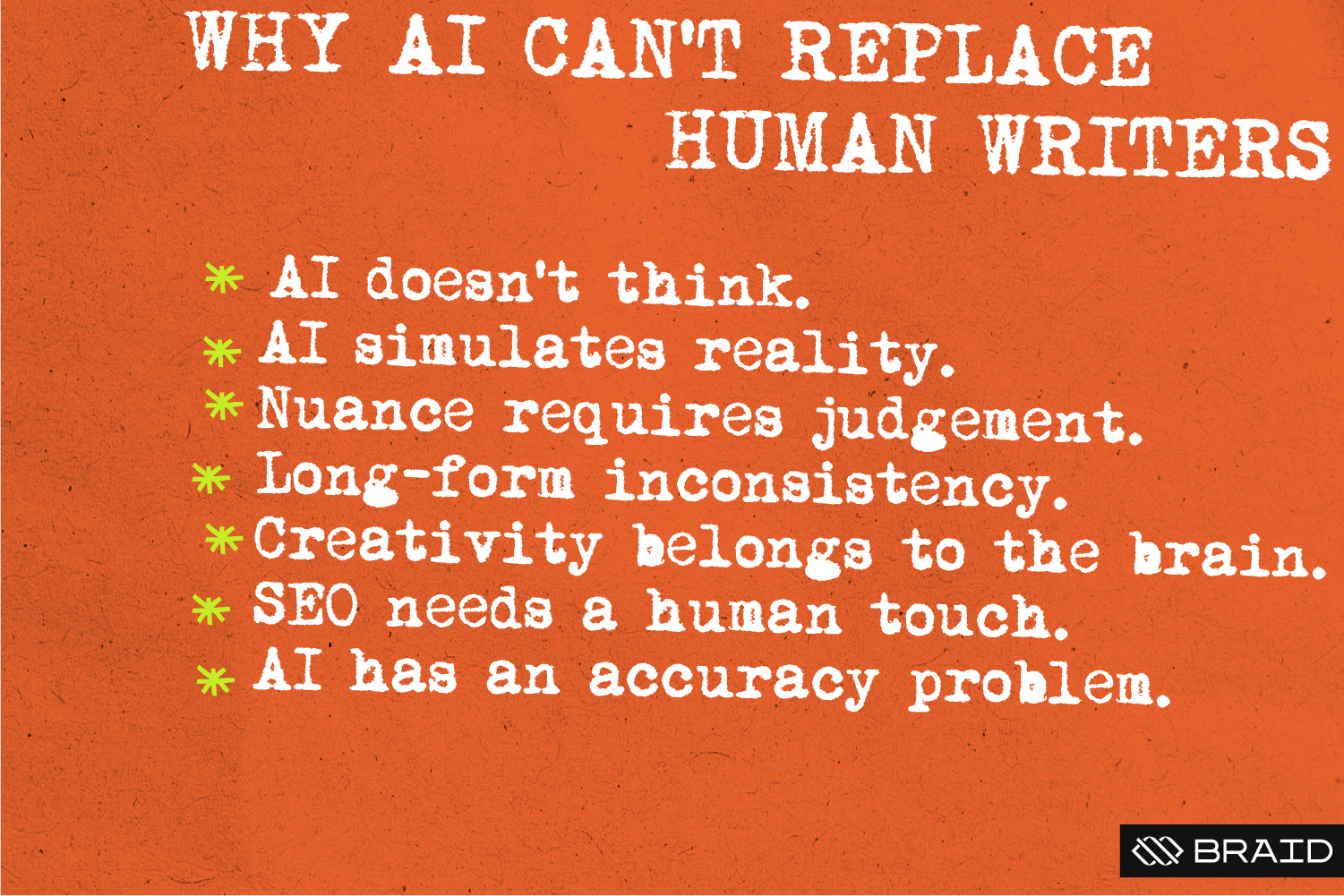
7 reasons why AI can't replace human writers
1. AI doesn’t think.
Tools like ChatGPT and Jasper generate text through statistical prediction. They're amazing at replicating patterns, but they don’t reason.
They can string words together in ways that are sometimes beautiful, but they're essentially unthinking language golems that don't understand irony, truth, or subtlety. Even at it's best, AI is a pattern matcher that pretends to grasp meaning.
2. AI simulates reality.
AI systems have insatiable appetites. Like some bottomless maw, they've been fed the most brilliant literature ever written, but their output is merely a statistical average of what already exists. It reads fine but rarely surprises because it can't channel lived experience like heartbreak, triumph, or tragedy.
Humans, on the other hand, are creatures of bias and humor and memory. They arrange words, yes, but they also convey emotions and ideas based on lived experience.
3. Tone and nuance still require judgment.
AI is a ventriloquist dummy. It can simulate tone when prompted, but it can't understand why a certain tone works in context. For example, AI doesn’t sense when humor crosses into cringe or when sincerity feels forced.
Human editors have instinct and intuition and can spot when tone needs to shift or something is better left unsaid.
4. Long‑form consistency breaks down.
AI tools can write short snippets of text with ease, but as length increases, themes repeat, points contradict, and style drifts. Tools like NovelAI attempt “memory,” but it’s limited to a few thousand words.
Human writers, on the other hand, can track the full complexity of long-form pieces and effortlessly balance narrative logic, emotional continuity, and pacing.
5. Creative risk is a byproduct of the human brain.
This one's huge. AI writing tools are fundamentally risk averse. Why? Because they're built to predict which words are most likely to come next in a sequence of words. That’s literally the opposite of creativity.
Great writing thrives on quirks like odd metaphors and breaks in rhythm, and human writers have an uncanny ability to create meaning by subverting grammatical, stylistic, and rhetorical rules.
6. SEO content still needs human hands.
Even platforms like Writesonic or SurferAI can’t satisfy Google’s E‑E‑A‑T (Experience, Expertise, Authoritativeness, and Trustworthiness) signals alone.
Search engines reward authentic perspectives over recycled phrasing. To rank, human writers and editors must still:
Structure content to clarify message intent.
Choose keywords that bolster content strategy.
Inject personal observations, experience, and insights.
AI is very good at drafting scaffolding, but humans are needed to create the kind of rich, detailed writing that actually ranks in search.
7. AI has an accuracy problem.
AI feels no remorse. It can generate any authoritative claim you want, but that doesn't mean it's true (and quite often, it's not).
Human writers possess a sense of moral responsibility that machines don't have, and readers (who are in the midst of a trust crisis) are increasingly seeking voices they can rely on—which is why human bylines, editors, and fact-checkers are more essential than ever.
Calvin's eyes are closed. I can't tell if he's been listening, but he exhales and says, "I hope you're right."
We sit in silence. Taste of Schezuan is nearly empty, and the red glow of paper lanterns and MSG in my veins makes me drowsy.
Calvin looks paranoid. His eyes dance the room. I decide to wait until tomorrow to tell him about Marty, but he leans close and whispers, "Marty isn't just a random writer who walked in off the street. He's my grandfather."
AI writing tool comparison
DATA ANALYSIS
Back at my hotel, I lay supine on the bathroom floor. The ceiling spins. My stomach swirls. It's Schezuan's Revenge. There will be no sleep for me tonight, so I drag myself to a tiny desk and spread my case files.
Calvin's confession echoes in my ears. Marty, aka Martin Gladwell, aka Calvin's maternal grandfather, had been missing without a trace for nearly 70 years, only to return to the same ad agency where he was last seen, somehow typing at the speed of algorithms.
Nothing about this case makes sense. Calvin was too frazzled to provide any helpful details back at the restaurant, so I pull out the AI drafts and inspect the output more closely.
I'm hoping to find some detail that'll help me better understand who, or what, Marty is. I catalog the results under four dimensions: speed, features, style, and detail.
The evidence tells a story, though not one I can easily explain.
Speed
AI tools operate at quantum velocity. Jasper, Copy.ai, and Writesonic produce drafts in seconds. I'm talking polished, grammatically correct, and structured for SEO performance. You enter a prompt and the content just—appears.
For writers juggling deadlines and large-scale projects, this type of efficiency is invaluable. But there's a tradeoff—these tools are painfully predictable.
The output feels like it was written by a sentient machine that stays within the bounds of what’s been written before. It's never truly spontaneous, surprising, or inspiring.
Features
Each platform has a distinct specialization:
Jasper offers 50+ templates for blogs, ads, and landing pages, plus a “brand voice” feature that learns tone across teams.
Copy.ai focuses on idea generation and rapid iteration, and excels at producing taglines, captions, and ad variants.
Writesonic bridges short-form ads and long-form SEO content with keyword optimization and automatic formatting for headings and CTAs.
Sudowrite caters to fiction writers, with “Describe,” “Expand,” and “Brainstorm” functions that mimic a co-author’s creativity.
Grammarly and ProWritingAid deliver readability scoring, tone checks, and deep syntax analysis.
Hemingway Editor reduces complexity by highlighting long sentences and adverbs and offering clearer, more concise alternatives.
Style
AI mimics tone with clone-like precision. It can express confidence, playfulness, or professionalism—but the results feel sterile, as if written by an author who studied humanity from afar.
Repetition is also common, and nearly identical phrases appear on loop. That said, AI outputs are readable, and on occasion, can even be elegant and unexpected.
Detail
One of the more troubling things I notice about AI content is a lack of depth and insight.
These tools produce content that flows and has the appearance of professionalism—paragraphs are orderly, and transitions are smooth—but the underlying information is shallow.
It takes a human to make the intuitive associations and microscopic observations that give writing texture.
Across every metric, the AI tools show glimmers of promise, but they're fundamentally flawed. They replicate competence but lack consciousness.
Marty's writing, on the other hand, is distinctly, undeniably human. I don't understand his supersonic writing skills or the impossible timeline of his disappearance and re-emergence, but his writing is real and raw and most certainly not AI.
My nausea swells, but as I crawl to the bathroom, Marty materializes in my hotel room and touches my tummy with a glowing index finger. The sickness instantly subsides. He helps me to my feet and says we need to talk.
Can AI detection tools identify human writing?
UNEXPLAINED VARIABLES
I'm back at Titan, and Calvin's in a tizzy. He won't listen to anything I say about Marty. He's ranting about cryptic videos in his social feed and swears he hears breathing in his earbuds. "First Mary, now me!"
I grab his collar and try to explain why I think Marty's writing is human, but he demands proof. Luckily, I've assembled the top AI detection tools, and I'm not leaving until he's convinced that Marty is flesh and blood.
How AI writing detectors work
Most of these detection systems rely on advanced forms of linguistic forensics. They measure perplexity (how surprising a text is) and burstiness (the text's variation of sentence length).
They also analyze rhythm, semantic repetition, and the distribution of punctuation to determine if the text was AI-generated.
A high perplexity score signals unpredictability, which means a human likely wrote it. I hand-selected the best of the best to test Marty's work:
Originality.ai
Copyleaks
GPTZero
Winston AI
QuillBot
Top AI detection tools
1. Originality.ai
Strengths
One of the most trusted tools among publishers and SEO professionals.
Scans for plagiarism and AI likelihood in one pass. Integrates neatly into editorial pipelines through
Chrome extensions and is particularly effective for long-form marketing and blog content where originality affects ranking.
Weaknesses
Expensive when you need to scan large amounts of text.
It's highly sensitive, and false positives are frequent when writers heavily revise or use unusual syntax.
2. Copyleaks AI Content Detector
Strengths
Strong multilingual coverage (30+ languages).
Its detection model analyzes linguistic structure rather than surface-level word frequency, which improves recognition of phrasing across GPT, Claude, and Gemini.
Particularly effective for identifying AI use in academic or technical prose.
Weaknesses
Struggles with hybrid drafts where human and AI text intermingle.
Creative seems to trigger false alarms, as does text that includes idiomatic or culturally specific phrasing.
3. GPTZero
Strengths
Uses a transparent scoring model based on “perplexity” and “burstiness” that makes it useful in classrooms or editorial settings where explainability matters.
Performs best on unedited AI text and provides color-coded confidence results that are easy to interpret.
Weaknesses
Loses accuracy on rewritten or polished drafts—a problem in professional settings where AI output is commonly post-edited.
Often penalizes concise or uniform writing styles and is unreliable with samples under a few hundred words.
4. Winston AI
Strengths
Combines AI detection, plagiarism scanning, and image verification for complete content auditing.
Especially strong for SEO teams and enterprises that need automated checks at scale.
The UI provides detailed probability maps and section-by-section breakdowns.
Weaknesses
High subscription cost and mixed accuracy reviews from independent testers.
Some note unpredictability in its scoring model, as it tends to mark highly polished human writing as synthetic.
Lacks transparency about underlying detection framework, which may reduce trust among data-driven users.
5. Turnitin AI Detection
Strengths
The academic benchmark for plagiarism scanning has AI detection that leverages its massive database of student submissions and online sources.
Integration with LMS platforms makes it convenient for educators and corporate training environments.
The system allows for targeted reviews by flagging suspect sentences rather than entire documents.
Weaknesses
Detection reliability varies widely across subjects and writing styles.
Creative or narrative assignments often trigger false positives.
Privacy concerns have led some universities to disable the AI module entirely.
When it comes to Marty's work, including his ads from the 1950's, every detector agrees. There's zero trace of AI in his work. His writing contains all the hallmarks—the irregular rhythms, offbeat idioms, and emotional dissonance—of human thought.
I can see Calvin failing to compute the results, so I call him into a smoke-filled conference room. Marty emerges from the haze and asks "Did you tell him?"
"I thought it should come from you."
Marty repeats what he told me at the hotel the night before. That he has no memory of the time gap. One second he was brushing his teeth in 1958, the next he was walking the streets of modern-day New York, Remington case in one hand, referral from a temp agency in the other.
He says he's imbued with a strange sense of confidence, like an unalterable objective has been implanted in his mind. "Go to Titan and write." The supernatural speed is a mystery to him, but he says he doesn't feel like he's typing fast. And his healing touch? "I haven't a clue."
A low hum vibrates the walls, and the lights flicker. A faint green glow fills the room. Marty's eyes go black, static pours from his mouth, and he disappears.
7 benefits of human creativity in an era of AI tools
CASE STATUS
The night is silent except for the rattle of train tracks. Calvin's hands quiver as we approach the old Gladwell residence—Marty's home before he disappeared in 1958. The house has remained in the family all these years. It's empty but not neglected.
Calvin unlocks the front door, and cigarette smoke lingers as we make our way to the dinning room. Marty's Remington sits atop a solid oak table, a pristine stack of paper beside it. It's a manifesto, thousands of pages long. Across the cover, the title juts out at us defiantly.
Human imagination in the age of artificial creativity
In that moment, Calvin and I inherit Marty's supernatural speed, and a document that should take weeks to read is consumed in minutes. Its core findings leave us astonished:
1. Creativity thrives on limitations.
Constraints on time, resources, and skill force the mind to improvise and create an internal tension and struggle that gives birth to originality. The greatest works of human creativity rarely emerge from abundance, but necessity.
2. The mind is the birthplace of meaning.
Every creative act is a reinterpretation of reality. Writers and artists take ordinary moments and transform them into symbols and images that help others understand themselves more clearly.
3. Emotion is the bedrock of memory.
People remember feelings. Creative work that evokes genuine emotions, such as humor and vulnerability, etches itself more deeply into a person's memory than work that prizes logic or technical precision.
4. Curiosity fuels invention.
Creativity flourishes when questions abound. The most inventive minds aren't satisfied with surface-level answers and never stop probing, never stop experimenting, never stop asking “what if...”
5. Style reveals individuality.
Imitation is how we learn, but style is what evolves when we begin to trust our unique ways of viewing the world—quirks and all—and have the courage to express that in our own voice.
6. Collaboration expands possibility.
Creative breakthroughs often happen when we venture outside ourselves and work with others. Writer and editor. Painter and critic. Musician and audience. By combining views, we achieve what no mind can conceive on its own.
7. Culture depends on human creativity.
Every generation alters society through the art it makes and the stories it tells. The continuation and evolution of traditions and cultures must be human-led.
Calvin's weeping. Marty's words are a warning and an exhortation. A rallying cry to remember that humankind is the animating energy of creative expression and that our artistic efforts shouldn't be outsourced to machines for the sake of speed, precision, or increased profits.
As we leave the house, we look up at the cold and empty night. Calvin pulls the manuscript close and whispers, "He's gone again." I nod, and a faint green star streaks the sky as it hurtles towards the Elysian Fields.
Case status: Unsolved.
FREE SENTENCE REPHRASER
Download the Chrome extension to start rephrasing and refining.
FAQs
Is AI-generated writing bad for SEO?
AI-generated writing is not automatically bad for SEO, but content created entirely by AI often struggles to rank without human editing. Search engines reward original insights, firsthand experience, and clear expertise—areas where AI writing tools tend to fall short. AI-generated content is most effective for SEO when used as a support tool and refined by human writers who add depth and authority.
Does Google penalize AI-written content?
Google does not penalize content because it was created using AI writing tools. However, Google’s algorithms actively demote low-quality content that lacks usefulness, originality, or trustworthiness. Pages that rely on generic AI-generated text without human oversight often fail to meet Google E-E-A-T standards, which can negatively impact rankings.
Can AI writing be reliably detected?
AI writing detection tools can identify obvious or unedited AI-generated text, but their accuracy is inconsistent. Many AI detectors struggle with human-edited drafts, creative writing, and technical content. As AI writing tools evolve, detection will become more probabilistic, making false positives and false negatives more common.
Why do AI detection tools often disagree?
AI detection tools rely on different methodologies, such as perplexity analysis, burstiness, sentence structure, and semantic patterns. Because there is no single definition of what “human writing” looks like, detectors frequently return conflicting results. Highly polished human writing and hybrid human-AI content are especially difficult to classify.
How do professional writers use AI writing tools today?
Professional writers use AI writing tools to brainstorm ideas, generate outlines, summarize research, or create rough drafts. The final content is shaped through human judgment, decision-making, and fact-checking. This hybrid approach allows writers to improve efficiency without sacrificing originality, voice, or credibility.
Can readers tell when content is written by AI?
Readers can often recognize AI-written content, particularly in long-form or opinion-based writing. Common signals include generic phrasing, shallow analysis, and repetitive sentence structures. Human writing tends to feel more specific, intentional, and grounded in real experience—qualities that readers actively seek.
FREE SENTENCE REPHRASER
Download the Chrome extension to start rephrasing and refining.